
In 2026, the cloud is everywhere. Yet barely twenty years ago, the idea of entrusting your data and software to remote servers seemed futuristic — even risky. How did this technology evolve from a marginal concept into the invisible infrastructure that underpins our digital lives?
What Was the Cloud Like Before the Cloud Existed?
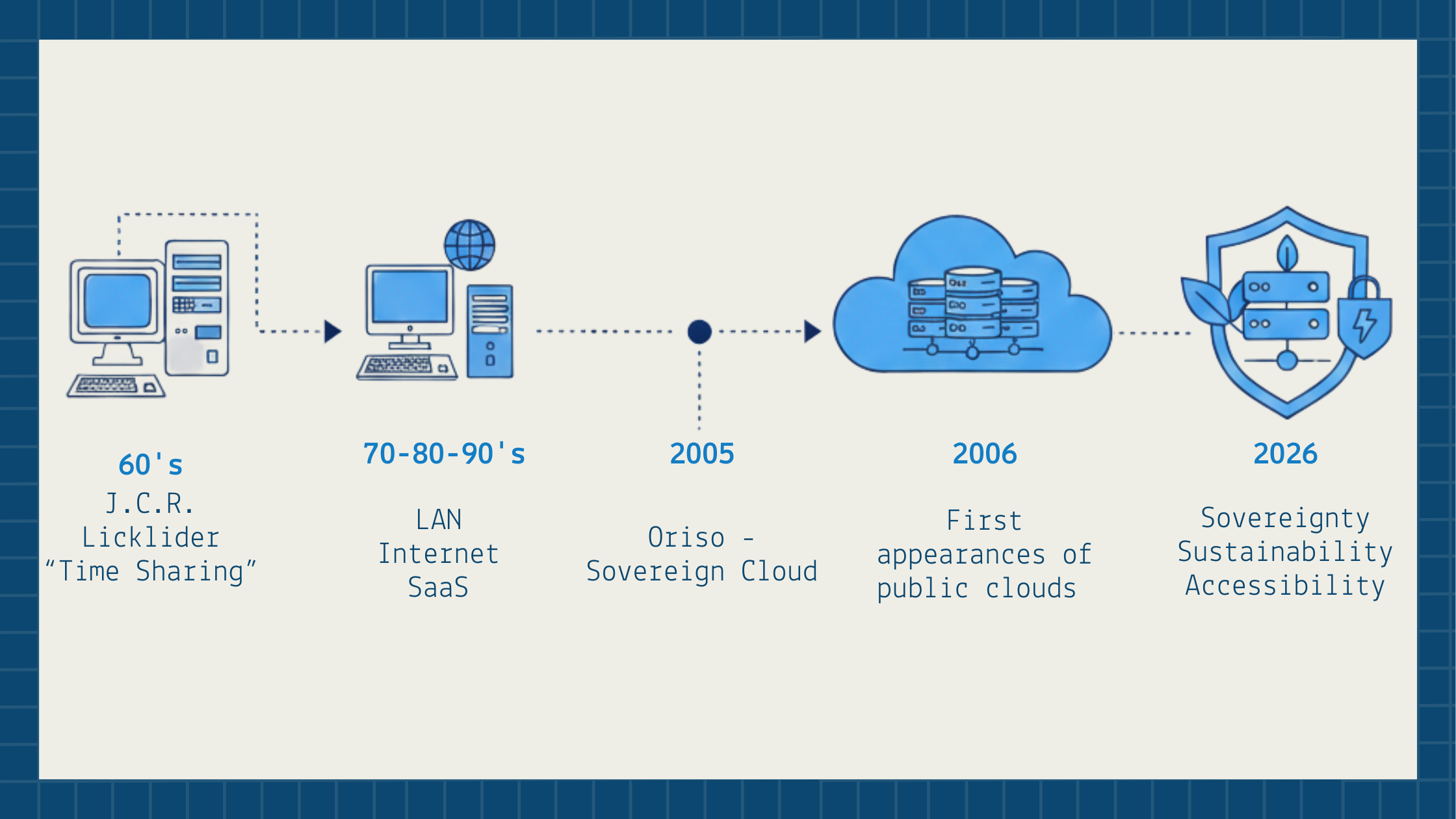
The history of the cloud goes back much further than most people think. As early as the 1960s, visionary computer scientists like J.C.R. Licklider imagined a network where users could access programs and data from any terminal. This concept, known as “time-sharing,” laid the foundation for the modern cloud by allowing multiple users to share the resources of a central computer. At the time, computers were massive and expensive machines, reserved for large institutions.
In the 1970s and 1980s, with the emergence of local area networks (LANs) and early communication protocols such as TCP/IP, the idea of sharing computing resources remotely began to take shape. However, it wasn’t until the rise of the Internet in the 1990s that the first “online” applications appeared. Companies like Salesforce, founded in 1999, became pioneers of Software as a Service (SaaS), offering software accessible through a web browser without local installation.
A major turning point came in 2006, when Amazon Web Services (AWS) launched its first public cloud services. For the first time, businesses and individuals could access computing resources on demand without investing in expensive hardware. Google and Microsoft quickly followed with Google Cloud and Azure, democratizing access to virtually unlimited computing power.
The Unsung Pioneers: Bold Entrepreneurs
While tech giants popularized the cloud, smaller companies played a key role in its development. And believe it or not, Oriso was one of them, among the first to offer remotely managed servers to its clients. At the time, the idea was revolutionary:
“We installed servers at our clients’ offices and managed them from our own,” recalls François Michaud, co-founder of Horizon. He adds, “In 2005, we built our own ‘central hub’ to offer fully online environments, long before the word ‘cloud’ became common.”
The challenge, however, was significant. Clients — and especially banks — had to be convinced. Subscription-based recurring revenue models, now standard, were poorly understood by financial institutions at the time. “Banks didn’t understand this transition.”
Establishing Yourself as a Sovereign Cloud Provider
The launch of AWS in 2006 was undeniably a turning point. Yet a competitive ecosystem continues to thrive.
Today, AWS, Google Cloud, OVH, and Microsoft Azure dominate the market. However, players like Oriso stand out — particularly because of one critical factor: data sovereignty. This approach helps protect data from foreign legislation such as the U.S. Cloud Act.
“The big players create ecosystems that lock in their customers,” explains François Michaud. Oriso develops tools that simulate the microservices of hyperscalers, allowing clients to migrate more easily from one cloud to another.
The Next Challenges for the Cloud
In a constantly evolving world, it’s essential to anticipate the challenges the cloud must face:
Data Sovereignty
With today’s geopolitical tensions, sovereignty is at the heart of concerns. For example, the U.S. Cloud Act allows authorities to access data stored abroad by U.S. companies. To avoid this, more and more organizations are turning to sovereign cloud providers that ensure data remains under local jurisdiction.
Environmental Impact
Data centers have a growing environmental footprint. Reducing it will require investment in renewable energy, infrastructure optimization (intelligent cooling, virtualization), and stricter energy efficiency standards.
Democratization
Did you know that 80% of executives in Canada store their data with hyperscalers? It is therefore essential to highlight sovereign cloud solutions and make them accessible and easy to use across all industries.
Let’s remain bold and visionary.
A Technology Still Shaping the Future
The early days of the cloud were marked by bold pioneers, resistance to change, and constant innovation. Today, the cloud is a pillar of our digital world — yet its potential is far from exhausted. Between sovereignty, sustainability, and accessibility, tomorrow’s challenges promise to make this technology even more essential and more responsible.